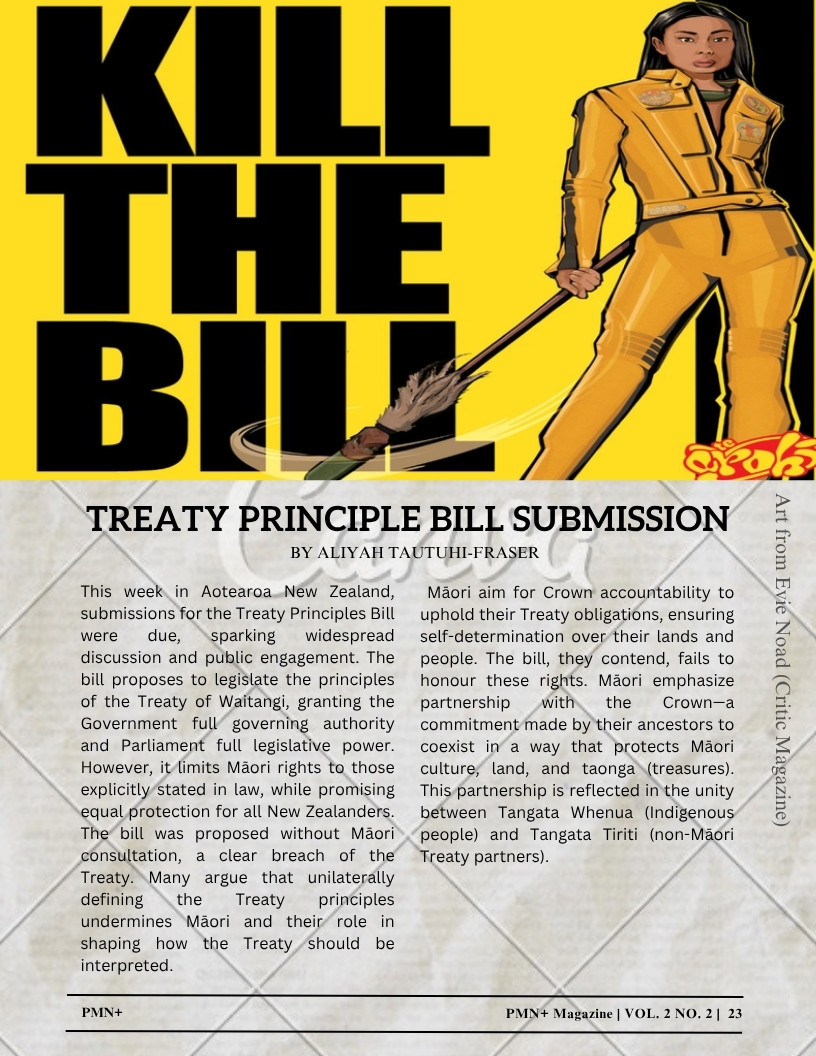
This week in Aotearoa New Zealand, submissions for the Treaty Principles Bill were due, sparking widespread discussion and public engagement.
The bill proposes to legislate the principles of the Treaty of Waitangi, granting the Government full governing authority and Parliament full legislative power. However, it limits Māori rights to those explicitly stated in law, while promising equal protection for all New Zealanders. The bill was proposed without Māori consultation, a clear breach of the Treaty. Many argue that unilaterally defining the Treaty principles undermines Māori and their role in shaping how the Treaty should be interpreted.
Māori aim for Crown accountability to uphold their Treaty obligations, ensuring self-determination over their lands and people. The bill, they contend, fails to honour these rights. Māori emphasize partnership with the Crown—a commitment made by their ancestors to coexist in a way that protects Māori culture, land, and taonga (treasures). This partnership is reflected in the unity between Tangata Whenua (Indigenous people) and Tangata Tiriti (non-Māori Treaty partners).
Earlier this year, thousands marched across the country in protest against the bill. The demonstrations drew support from other Pacific communities who highlighted the importance of respecting Māori as the ancestral stewards of Aotearoa. These communities, recognizing their own shared histories of colonization, joined in advocating for a multicultural approach that centres Indigenous voices.
On January 7, the final day for submissions, the community organization Reanga Taketake hosted a “sub-a-thon” concert in Auckland to encourage participation. The event brought together artists, activists, and performers, including JordynwithaWhy (2023 Māori Music Awards Best Female Artist), Tigilau Ness (Polynesian Panthers co-founder/artist), and Michel Mulipola (“Bloody Samoan” Disney Moana 2 story artist). The concert inspired 661 submissions and showcased the power of creative advocacy, exemplifying the practical application of partnership between Tangata Whenua and Tangata Tiriti.
As JordynwithaWhy reflected on the sub-a-thon, she shared:
“The event was really cool. It felt special to contribute, and I am really honoured to be a part of this kaupapa.” It was a cause she believed in deeply, and having politically driven songs, such as Toitū and Sovereign, aligned perfectly with the event. She also spoke about the inspiration behind composing these songs:
“My music is clearly political. Last year, when writing songs for my album, I wanted to capture the time we were in—a change in government and so many decisions being made around reo (language). It’s to not be spoken or seen on public signage, so I wanted to write songs that reflected the time. In the future, people can see the art created during that time and understand what was happening, based on real feelings.”
she added:
“I wanted to try and offer hope to our people. I knew we were going to be on the hīkoi and protesting. I was thinking about our people on the frontline and how music is important for us—not just for storytelling but for keeping us in a state of rangimārie (peace). That’s so important when we’re doing things that are confrontational, telling the truth, and being staunch in our beliefs.”
Polynesian cultures, including Māori, have long used creative expression—music, storytelling, dance, and haka—as powerful tools for resistance and unity. Haka, for example, has served as a medium to channel emotions, set challenges, mourn losses, and express staunch beliefs, as seen in Hana Rāwhiti Maipi-Clarke tearing up the bill’s principles in Parliament.
These cultural expressions amplify the voices of those opposing the bill and call for collective action to protect Māori rights.
As submissions have been extended to close on Tuesday 14th Jan 1PM, there is hope that the voices of thousands will be heard and that this moment of resistance will bring lasting change. Protecting the rights of Māori and honouring the Treaty is not only vital for today but for future generations, ensuring the legacy of partnership and justice continues in Aotearoa.
Images provided by the featured individuals or sourced from their public social media profiles and online platforms. All rights remain with the original creators. Originally published in PMN+ Magazine, February 2025 (Vol. 2 No. 2).
February 2025 · Digital Magazine