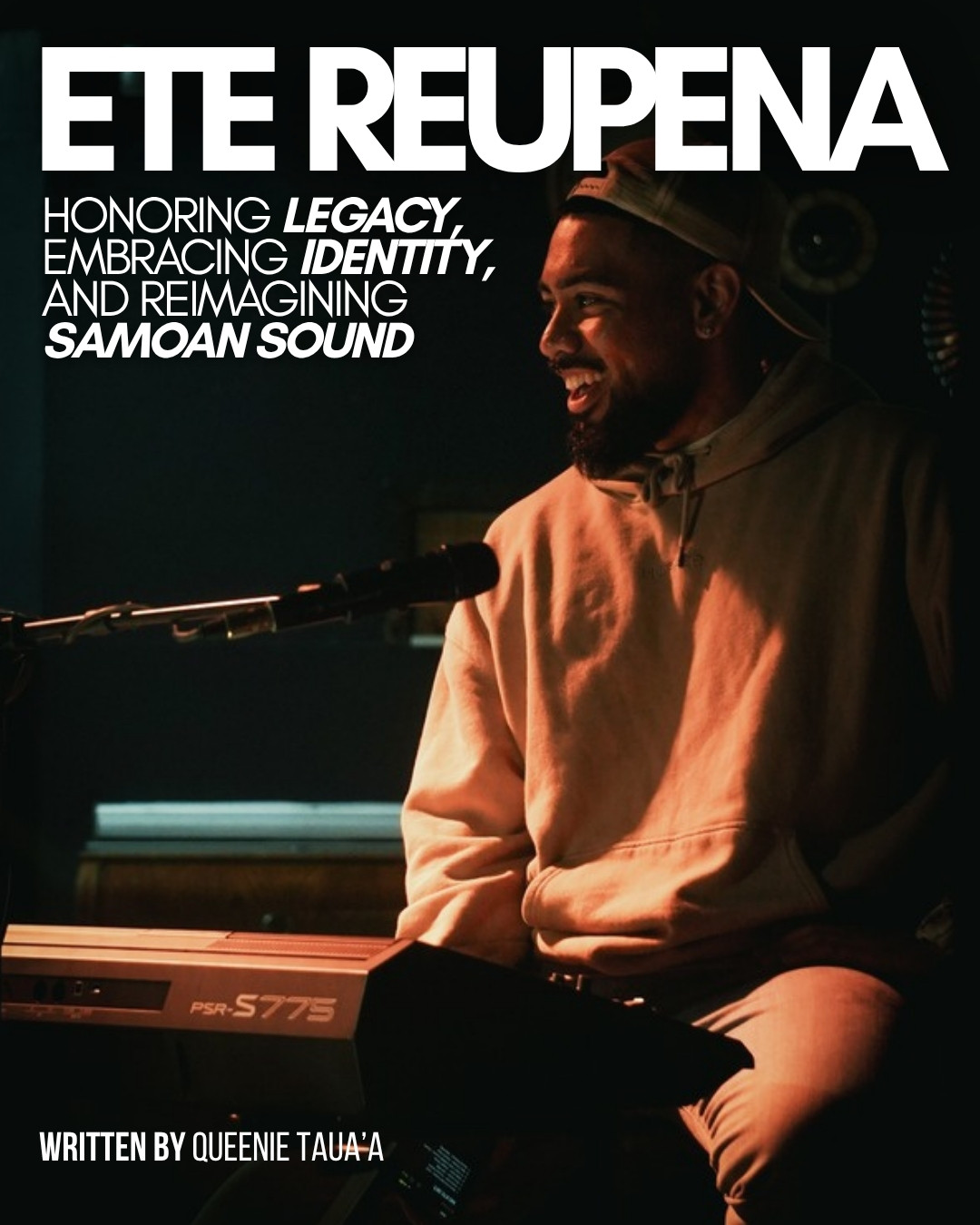
In an ever-evolving musical landscape where cultural preservation and creative freedom often intersect, few artists navigate that space as meaningfully as Eteuati Risatisone Reupena, known simply as Ete. A proud Samoan artist rooted in the villages of Vaoala, Falealupo, Lalomalava, Le'auva'a, and Falevao, Ete was raised in the islands but now calls Wellington, New Zealand home. His artistry reflects this duality, grounded in his heritage, yet boldly experimental in sound.
With a musical style he describes as "Samoan Pop," Ete merges the pulse of traditional Pacific rhythms with modern pop sensibilities. His latest release, a powerful reimagining of "Teine Ma Tama", pays tribute to the original work by Mt. Vaea Band and honors the legacy of the late Peneueta Solomona, a cultural pioneer in Samoan music. More than just a cover, Ete's version is a vessel for storytelling, layered with both nostalgia and newness.
Through a thoughtful Q&A, we caught up with Ete to talk music, meaning, and the moments that have shaped his journey so far.
Breakthrough Artist
Full Name / Artist Name:
Eteuati Risatisone Reupena / Ete
Where are you from?
I am Samoan, with roots that stretch across several beautiful villages (as we all are) Vaoala, Falealupo, Lalomalava, Le'auva'a, and Falevao, just to name a few. I was born in Aotearoa New Zealand, but I was raised in Samoa my entire life. Since 2017, I've been based in Wellington, New Zealand. It's become my second home and a place where I've been able to grow as an artist while still staying connected to my roots.
How would you describe your music style and sound?
I get asked this question a lot, and honestly I still don't have a clear-cut answer. My sound really depends on how I'm feeling or what's going on in my head at the time. I create a mix of different styles, and I don't like to box myself in creatively. That said, if we're going off what I've released so far, I'd probably describe it as Samoan Pop. It's rooted in my culture, but it's blended with modern pop influences, kind of like a reflection of who I am, grounded in my identity but open to experimenting with new sounds. It's always evolving, and I think that's what keeps it exciting for me.
How long have you been making music, and what inspired you to start?
I've been making music for as long as I can remember, probably since I was about 10 or 11. I was always fascinated by how music sounded. I'd spend hours just listening, breaking down songs in my head, figuring out the layers and I still do that to this day. I'd try to recreate what I heard on my little keyboard, just experimenting and learning by ear. But the moment I really knew I wanted to pursue music seriously was in 2012, when UB40 came to Samoa. Watching the way the crowd reacted to their music, the energy, the connection—it lit a fire in me. That's when I realized I wanted to create music that could move people like that, on a big scale.
Latest Release: "Teine Ma Tama"
Congratulations on your latest new single! For those who haven't heard it yet, can you describe what "Teine Ma Tama" is about? What inspired the song?
Thank you, I really appreciate that! So 'Teine Ma Tama' is a classic originally released by the Mt. Vaea Band in the early 2000s. The song dives into the struggles young people face and how the choices they make, especially the bad ones, always come with consequences. It's almost like getting a 'oke (a telling-off) from your parents, but it's delivered in a way that goes down easy—like the message is mixed into the music, the way you'd slip something into a drink. That's what makes it powerful: it's real talk, but it still vibes.
What was the creative process like when writing and producing this track? Was there a particular moment or feeling you wanted to capture?
The creative process for this track was really about finding that balance between honoring something classic and familiar, while reintroducing it to a new audience in a fresh and exciting way. From the start, I knew I wanted the chorus to be front and center. It's the most iconic part of the original, and it holds so much emotional weight and familiarity so leading with it felt natural. I've always believed the first few seconds of a song are crucial; that's the moment where people decide whether they connect with it or not. So I wanted to make sure it was instantly recognizable and hit with impact.
Sonically, I was intentional about keeping that heavy-hitting, classic Samoan sound that we all grew up loving those deep, rich tones that you feel in your chest. That warm low end is something we in the islands naturally gravitate toward, so I leaned into that, but with my own spin. It was important for me to keep the cultural heartbeat alive while still making it feel current, fresh, and true to who I am as an artist. Ultimately, the goal was to create something that resonates across generations whether you remember the original or you're hearing it for the first time.
What message or feeling do you hope listeners take away from "Teine Ma Tama"?
As a listener, I really just want you to enjoy the music for what it is, whether that's through the lyrics, the melodies, or just the overall vibe. If the words and message resonate with you, I hope they speak to your heart and offer something meaningful. But if it's the beat that catches your ear, then that's just as important. Blast it at your next family gathering, play it at the next parade, let it bring joy and energy to whatever space you're in. Music is meant to be felt, however it connects with you. Whether you're diving deep into the story or just dancing along, I'm happy you're experiencing it.
Did you collaborate with anyone on the song (producers, writers, other artists)? If so, who and what was that collaboration like?
The original 'Teine Ma Tama' was written by the late Peneueta Solomona, who sadly passed away last year. Pene was not only a talented songwriter but also a founding member of the iconic FiaFia Band, a name that holds a lot of weight in the Samoan music scene. He was truly a pioneer, especially in the style we've come to know and love as "FOB jams." His music became a staple in many Samoan households, resonating across generations and setting the tone for a sound that's deeply cultural yet accessible.
This rendition is my way of honoring Pene and everything he contributed to Samoan music. It's more than just a cover, it's a tribute to his legacy, and a way to keep his spirit and storytelling alive for the next generation of listeners.
We love that this track is delivered in our mother tongue, Gagana Samoa. What significance does it hold for you to release a song in the Samoan language?
Samoan is my first language, so I felt it was only natural and important to start by putting our culture front and center in my music. For me, music is one of the most powerful ways to promote and preserve our language because it's accessible and easy to connect with. When people listen to a song, they absorb the language in a way that feels natural and enjoyable, even if they're not fluent. Through my music, I want to celebrate our roots and share the beauty of the Samoan language with a wider audience, both at home and around the world.
Artist Journey + Representation
What has been the most rewarding part of your music journey so far?
I'm still in the early stages of my music career, but one of the most rewarding parts of this journey has been sharing what I've learned with other artists. There's a deep sense of fulfillment that comes from supporting others and helping bring their creative visions to life. I don't believe in gatekeeping, I've always embraced a "village mindset." Even if we don't have much, when we share what we do have, we create a kind of wealth that goes beyond material things. Together, we all grow.
What challenges have you faced as a Polynesian artist in the music industry, and how have you overcome them?
A personal challenge I've faced was figuring out who I am as an artist and what my sound should be. I'm influenced by so many different styles that it was tough to narrow things down or fit into a specific genre. For a while, I felt pressured to define it, but eventually, I realized I don't need to limit myself. Instead, I've chosen to make what I love and let my sound grow and evolve over time. That mindset has helped me stay true to myself creatively.
How important is it for you to represent your culture in your music?
Absolutely that's a huge part of my identity. Our aganu'u (culture) and fa'asinomaga (sense of belonging) are what make us unique and set us apart. When you look at the rise of Afrobeats, for example, it's really just traditional African rhythms fused with R&B, pop, and other global sounds. And it's taken the world by storm. That's the kind of movement I'd love to see for Polynesian music, taking our traditional sounds, blending them with modern influences, and sharing them on a global stage. There's so much richness in our music and stories. I believe the world is ready for it.
Who are some artists or cultural figures that have influenced you, either musically or personally?
Growing up in Samoa, music wasn't as accessible as it is today, so my earliest influences came directly from what my parents listened to. I became instantly attached to the sounds of Michael Jackson, ABBA, Elvis Presley and a whole lot of movie soundtracks. Those songs became the music of my childhood. As I got older and started exploring more on my own, I discovered artists like Te Vaka, Fiji, Vaniah Toloa, and even Kanye West, Timbaland, Metallica and Toto each of whom expanded my understanding of what music could be emotionally, culturally, and creatively.
Church music has also been a huge part of my life. I was raised in the EFKS (Ekalesia Faapotopotoga Kerisiano Samoa) church, and like many Polynesian artists, my musical roots are deeply tied to the harmonies and spiritual messages we grew up singing in church. That environment shaped not only my voice but also the way I connect to music emotionally and spiritually. So my influences are really a mix of global icons, Polynesian storytellers, and the sacred sounds of Sunday worship. All of that comes together in how I approach music today.
Looking Ahead
What's next for you: upcoming projects, performances, or collaborations you'd like to share?
I've got some exciting releases lined up for the rest of the year, including potentially a special track for White Sunday, which is always a meaningful celebration for us. On top of that, I'm incredibly honored to be representing Samoa in the International Artists Project, a collective of artists from every country in the world. We're coming together to release a World Album scheduled for August 1st, and what makes it even more special is that the album has been submitted for GRAMMY consideration in the Best Global Music Album category for the 2026 GRAMMYs. It's a huge milestone, and with God's blessing, I'm hopeful everything will go well. It's been an amazing journey so far, and I'm excited to share more music.
Where can people stream "Teine Ma Tama" and follow you online?
Teine Ma Tama is available on Spotify, Apple Music and Youtube now so make sure to go have a listen if you haven't already.
And if you want to follow my journey:
- Instagram @etereupena
- Facebook Ete Reupena
- TikTok @officialetereupena
- YouTube @OfficialEteMusic
Anything else you'd like to share with your fans, our readers, or the Polynesian Music Network community?
Firstly I just want to acknowledge the passing of George 'Fiji' Veikoso. A loss that we all feel heavily in the polynesian music community. For so long he has brought the pacific together and is the reason why we share one common heart beat and one sound. How blessed are we to have been alive during his time! RIL Fij, vinaka vakalevu. To my listeners and followers, thank you for all your love and support towards the project! Ia alofa le Atua ma toe fa'atutumu mea ua to'esea ona o lenei 'au'auna fa'atauva'a. Thank you PMN+ team for giving me the opportunity to share my story and artistry! You guys are killing it and thank you for such an amazing platform. Fa'afetai mo lo'u avanoa.
Fa'afetai tele, Ete.
And in that spirit of honoring those who paved the way, of lifting others up, and of staying true to cultural identity, Ete's journey is not just one of personal growth, but collective evolution. His music bridges generations, villages, and visions. And as his story continues to unfold, it's clear he's not only creating songs, but helping define the sound of modern Polynesia.
Images provided by the featured individuals or sourced from their public social media profiles and online platforms. All rights remain with the original creators. Originally published in PMN+ Magazine, August 2025 (Vol. 2 No. 8).
August 2025 · Digital Magazine